How to Create a Salon Price List (With Examples)

A good salon price list makes choosing and booking a treatment simple. Clear service categories, appointment durations and transparent prices give clients the information they need, while making sure every treatment makes financial sense for your business.
But pricing isn't always straightforward. Between rising costs, local competition and the time that goes into each appointment, there's more to consider than what the salon down the road charges.
In fact, Fresha's research found that 68% of hair professionals aren't charging enough. It's a good reason to give your pricing a closer look.
Whether you're opening your first salon or refreshing an existing menu, we'll cover how to price salon services, organize your treatments and create a price list clients can navigate confidently.
And with Fresha's all-in-one salon software, you can manage your services, prices and bookings together.

What to include on a salon price list
Think about booking somewhere new. You want to know what you're getting, how long it'll take and how much it'll cost.
Your clients are no different.
A menu filled with vague descriptions or similar-sounding treatments can turn a simple booking into a guessing game. Your team might know exactly what a partial balayage includes, but someone booking their first color appointment probably won't.
Here's what your salon services price list should include:
- Service categories: Group treatments logically, such as Haircuts, Color, Styling and Treatments.
- Clear service names: Use recognizable names with descriptions where needed.
- Appointment durations: Let clients know how much time to allow.
- Transparent prices: Display fixed prices or realistic starting prices.
- What's included: Explain whether toner, shampooing or finishing services are included.
- Service variations: Account for hair length, complexity or specialist techniques.
- Add-ons: Make complementary treatments easy to discover.
- Team member pricing: Explain differences between stylist levels.
- Booking policies: Make deposits and cancellation terms easy to find.
Take an all-over color service, for example. A listing that simply says "All-Over Color, $100" doesn't give a new client much to go on. Compare that with:
All-Over Color | From $100 | 120 minutes
Includes a color consultation and application. Toner and finishing services are booked separately.
Suddenly, there's far less room for confusion. Clients know what they're booking, and your team spends less time answering the same questions.
“Nobody wants to spend ages figuring out which treatment to book or what's actually included. A good salon menu should make that decision really simple. Clear descriptions, upfront pricing and a little extra detail can go a long way in helping clients feel confident about booking with you.”
Iasmina Ionescu, Content Marketing Manager at Fresha
If you're building your menu from scratch, Fresha's service menu best practices are a useful starting point. You can also create services, allow extra appointment time and set payment policies, all without making your menu unnecessarily complicated.
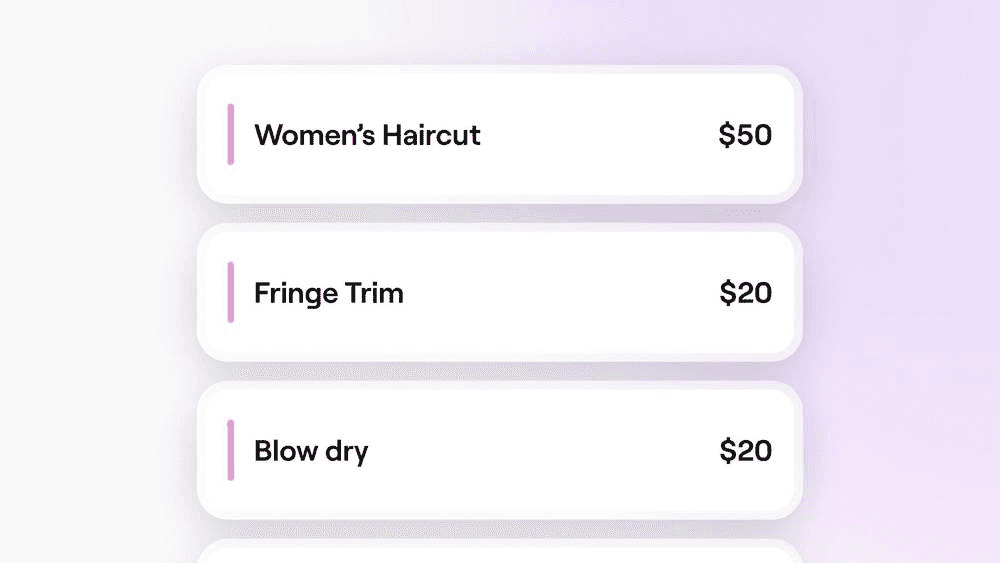
How to set a price for each service
It's tempting to look at what nearby salons charge, choose something similar and hope it works. After all, if the salon around the corner charges $70 for a haircut, surely that's a reasonable starting point?
Well, not necessarily.
Their rent might be half yours. They could have a completely different staffing model, use different products or specialize in treatments that bring in more revenue. What works for their business won't automatically work for yours.
The first thing to get comfortable with is your own costs.
Think about everything that goes into keeping your salon open, from rent and utilities to insurance, software and equipment. Then work out how many hours you're realistically able to book each week. Not every minute of the working day is spent with a paying client, so remember to account for cleaning, consultations, breaks and gaps between appointments.
Labor is another big consideration. According to the US Bureau of Labor Statistics, median hourly wages in May 2025 were $17.21 for hairstylists and cosmetologists and $18.37 for barbers. While these aren't suggested service prices, they're a useful reminder that your team's time needs to be accounted for.
Then there's product usage. A straightforward haircut might involve relatively little, while a color correction could require several rounds of mixing, application and processing.
And with costs continuing to climb, those details matter. In the NFIB's September 2026 survey, 20% of US small-business owners named inflation as their single biggest problem. Salons aren't alone in feeling the pressure.
So, what does all of that look like when you put it into numbers?
Here's a simple salon pricing structure for a 60-minute appointment:
| Expense | Example amount |
| Operating costs | $15 |
| Labor | $20 |
| Products | $5 |
| Total service cost | $40 |
| Target contribution margin | 20% |
| Calculated service price | $50 |
With $40 in costs and a target contribution margin of 20%, you'd divide $40 by 0.80 to arrive at a service price of $50.
That leaves $10 after the costs listed above, although taxes, payment processing fees and other expenses not included in the calculation will affect your final profit.
Of course, no two salons will arrive at exactly the same number. That's the point. Your pricing should reflect the business you're actually running.
“There's so much more that goes into a salon appointment than the time someone spends in the chair. You've got years of experience, creativity and a whole lot of hard work behind every service. Your prices should reflect that. It's about knowing your worth, covering your costs and building a business that can really thrive.”
James Hayward-Brown, Head of Content & Brand Marketing at Fresha
Once your menu is up and running, Fresha's finance reports can help you keep an eye on performance, while its guides to team commissions and managing taxes cover some of the finer details.
And when the time comes to review your rates, our salon pricing guide explores how to approach price increases.
Check your prices against your area
Now that you've got a clearer idea of what your services need to cost, it's worth seeing how those numbers compare with other salons in your area.
Because let's face it, a haircut in the city probably won't come with the same price tag as one in a small town, but location only tells part of the story. Some salons have built a reputation around specialist color work, while others offer a luxury experience, work with premium products or have a team of highly experienced stylists. All of those things can influence what clients are willing to spend.
The trick is finding businesses that are genuinely comparable to yours.
Have a browse through the Fresha marketplace and look at how nearby salons present their services. What are they charging? How long are their appointments? Are consultations, treatments and finishing services included?
A $75 haircut with a consultation, shampoo and blowout isn't necessarily more expensive than a $40 dry cut. They're offering different experiences, and the price should reflect that.
It's worth comparing three to five businesses rather than relying on a single average salon price list. You'll get a much better sense of where your services sit within the local market.
There's also the wider industry to consider. According to the US Bureau of Labor Statistics Consumer Price Index, prices for haircuts and other personal care services rose 3.7% in the 12 months to September 2026.
That doesn't mean you need to increase your prices by 3.7%, of course. But it does show that pricing is changing across the industry, and reviewing your menu regularly is simply part of running a business.
Ultimately, you're not trying to win a competition for the cheapest haircut in town. You're trying to find a price that makes sense for your business and feels worthwhile to your clients.
Structure your menu: categories, variants and add ons
You've worked out your prices, checked out the competition and decided what you're offering. Now comes the part clients will actually see.
And this is where a little organization makes a big difference.
Imagine scrolling through a salon pricing menu with 40 different treatments, half of which sound almost identical. Not exactly the easiest way to book a haircut.
Instead, give everything a logical home. Haircuts, Color, Styling and Treatments are familiar categories that help clients find what they're looking for without too much thought.
You can organize your service categories and rearrange your menu through Fresha, putting your most popular appointments where clients can easily find them.
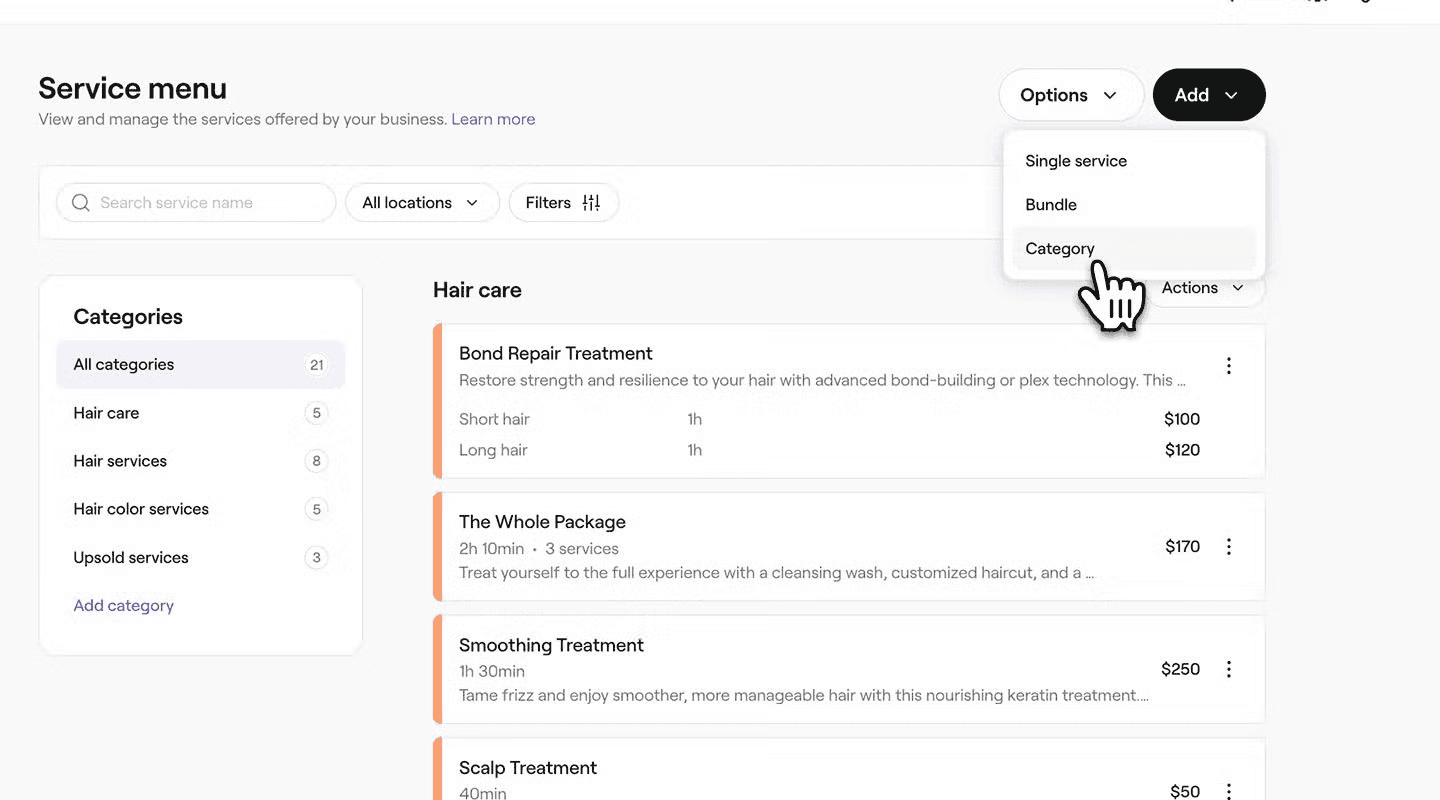
Then think about the services that need a little more flexibility.
Take blowouts. You might charge different amounts depending on hair length, but listing three completely separate treatments isn't always necessary. With service variants, clients can choose the option that suits them within one listing.
And if your senior stylists charge more than junior team members, you can set different prices and durations without having to duplicate your entire menu.
Don't forget those little extras, either. A conditioning mask after a color appointment, nail art alongside a manicure or a beard treatment with a haircut can make an appointment feel more personalized.
Fresha lets you offer these through service add-ons, while service bundles are useful for treatments that naturally go together.
If you're looking for more ways to introduce clients to your services, our guides to salon promotions and client loyalty are worth exploring.
Salon price list examples
Sometimes it's easier to see a good menu than to imagine one.
Whether you're looking for hairdresser price list examples, a barbershop menu or a beauty salon price list, the same principle applies: make the popular services easy to find and give clients enough detail to choose the right appointment.
Below are three illustrative salon price list samples using US dollar prices. They're examples to help you build your own menu, rather than verified averages from the Fresha marketplace.
Hair salon price list sample
| Service | Duration | Example price |
| Shampoo, cut & blowout | 60 min | $75 |
| Restyle & finish | 75 min | $95 |
| Blowout | 45 min | $50 |
| Root touch-up | 90 min | From $85 |
| All-over color | 120 min | From $130 |
| Deep conditioning treatment | 15 min | $30 |
There's a nice balance here between everyday appointments and more involved color services. The starting prices also leave room for consultations where the amount of work can vary.
One thing worth adding to a hair salon price list like this is a note explaining whether toner and finishing services are included. It's a small detail that can save an awkward conversation at checkout.
Barbershop price list sample
| Service | Duration | Example price |
| Classic haircut | 30 min | $35 |
| Skin fade | 45 min | $45 |
| Beard trim | 15 min | $20 |
| Haircut & beard trim | 45 min | $50 |
| Hot towel shave | 30 min | $35 |
For barbershops, there's usually no need to overcomplicate things. Most clients know exactly what they're coming in for, so a shorter menu with straightforward names works well.
The haircut and beard trim combination is also a good example of making two services easier to book together.
Beauty salon price list sample
| Service | Duration | Example price |
| Classic manicure | 30 min | $30 |
| Gel manicure | 45 min | $45 |
| Gel removal | 15 min | $15 |
| Brow shaping | 15 min | $25 |
| Brow tint & shaping | 30 min | $40 |
| Lash lift | 60 min | $85 |
Beauty menus can get quite extensive, particularly when you're offering nails, brows, lashes and other treatments under one roof.
The key is making sure clients can tell the difference between services without having to call the salon for an explanation.
You can even add images to your services through Fresha, which is especially useful for treatments where a visual example helps clients know what to expect.
Free salon price list template
Starting with a blank spreadsheet isn't particularly inspiring, especially when you've already got a salon to run.
The good news? Your first salon price list template doesn't need to be complicated.
Start with your categories, service names, durations and prices. You can always add more detail later.
| Category | Service | Duration | Price |
| Haircuts | Shampoo, cut & blowout | 60 min | $75 |
| Color | Root touch-up | 90 min | From $85 |
| Treatments | Deep conditioning | 15 min | $30 |
| Styling | Blowout | 45 min | $50 |
Once you've got the basics down, add columns for labor, product costs and profit margins if you're using the spreadsheet to calculate your prices.
Already using Fresha? You can export your existing service menu, which saves you from having to type everything out again.
Show your price list everywhere clients book
You've spent time getting your menu just right. The last thing you want is for clients to find an outdated version somewhere online.
And with so many ways to discover a salon these days, keeping everything consistent can be surprisingly tricky.
Someone might come across your latest color transformation on Instagram, search for a haircut on Google or find your business while browsing the Fresha marketplace. Wherever they land, they should see the same services, prices and booking information.
That's where having everything connected comes in handy.
With Fresha, you can manage your menu in one place and make it available through your connected booking channels.
Your Fresha marketplace profile lets clients explore your services and book appointments, while integrations with Google Search and Maps and Facebook and Instagram give them more ways to find you.
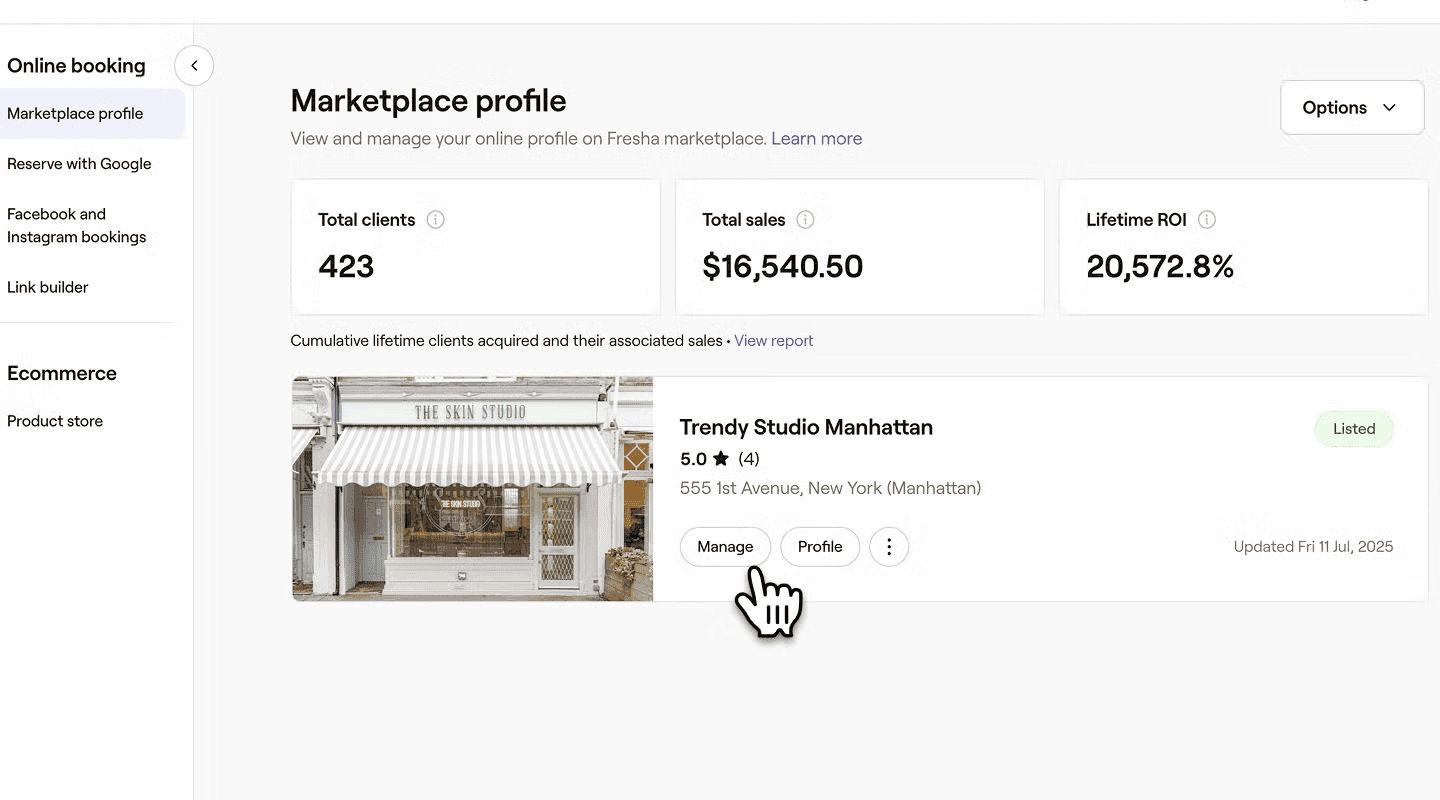
You can also share direct booking links or build your own website with Fresha's Smart Website Builder.
For more ideas, take a look at our guide to setting up online booking for your salon.
A well-planned price list does more than tell clients what a haircut costs. It helps them discover your services, book with confidence and understand the value of what you offer.
And with Fresha's all-in-one salon software, you can bring your services, bookings, payments and business insights together in one place, leaving you more time to focus on the work you love.
Frequently asked questions
What should a salon price list include?
A salon price list should include clear service names, prices and appointment durations, organized into categories that are easy to browse. Explain what's included in each treatment, any available extras and relevant booking policies. Clients should be able to understand their options and book without needing to ask for more information.
How do I price my hair services?
Start by calculating the cost of each appointment, including labor, products and operating expenses. Add your target profit margin, then compare similar services locally. The aim is to find a price that reflects your expertise, covers your costs and makes sense for your clients.
What is a good profit margin for a salon?
There's no single profit margin that works for every salon. It depends on location, staffing costs, services and business model. To calculate your net profit margin, divide net profit by total revenue and multiply by 100. Tracking this over time helps you understand how profitably your salon operates.
What are the main pricing strategies for salons?
Common approaches include cost-based, competitor-based, value-based and tiered pricing. Some salons focus on operating costs, while others consider local competition or the experience they offer. Combining these strategies can help you balance profitability with what clients are willing to pay.
What are the 5 C's of pricing?
The five C's are Cost, Customers, Competition, Company objectives and Channel. They provide a framework for thinking about pricing beyond the cost of delivering a treatment, considering client expectations, competitors, business goals and how services are sold.
Should I use 'from' prices on my salon menu?
Yes, particularly when the final price varies by hair length, product usage or treatment complexity. Make sure your starting price is realistic and explain what could affect the final amount. For more involved services, a consultation can help clients understand the likely cost before booking.
How many services should be on a salon menu?
There's no ideal number. Your menu should reflect what your team does best and what clients actually book. Keep categories clear, avoid unnecessary duplication and use variants or add-ons where appropriate. A shorter, well-organized menu is often easier to navigate than a long list of similar treatments.
Related Articles