Fresha’s Selfcare Report 2025

Each year, the beauty and wellness industry continues to evolve, but 2025 marked a period of acceleration. Using platform-wide data and behavioural insights, Fresha has analysed 2025’s year in selfcare to understand why certain services, aesthetics, and business strategies surged, while others seemed to fall away.
Executive Summary
At one point, the beauty industry felt comparatively static. For many of us, its most anchored symbol was Elizabeth Arden’s (still iconic) Eight Hour Cream, tucked away in our Mother’s handbag. Yet even then, the global wellness economy was still worth a whopping $3.37 trillion USD (2013) (Global Wellness Institute, Wellness Economy Monitor 2025), and only continued to grow, doubling in size to what reached a $6.8 trillion market in 2024 (Global Wellness Institute, Wellness Economy Monitor 2025). This underscores just how quickly the selfcare industry has shifted from a simple 3-step morning routine to a global industry powerhouse.
Throughout 2025, that momentum was on full display. We watched once-niche treatments like polynucleotide injections (salmon sperm facials) move into the mainstream. At the same time, at the top of the booking funnel, Y2K-inspired branding and nostalgia-led marketing reasserted their influence. Together, these moments revealed not just a change in taste but a wider recalibration of how consumers discover, value, and invest in their beauty services.
With over 140,000 businesses on the Fresha Marketplace in over 120+ countries, and 35 million appointments booked monthly, we’re leveraging Fresha’s dense global data to reveal how consumers are rethinking beauty and wellness. In this report, we will dissect the four core pillars of selfcare: Aesthetics, Hair & Beauty, and Wellness, alongside a dedicated analysis of the male selfcare sector, and reveal the key movements and trends that shaped selfcare in 2025.
Injectables
For our first category, we’re exploring aesthetics. Interestingly but not surprisingly, in 2025, injectables moved away from correctional appointments and more towards intentional growth and long-term commitment. Once carrying a very heavy stigma and largely defined by female bookers, the category is now shaped by all-gender participation, higher-value treatments, and a growing emphasis on longevity-led results.
Here are the two key takeaways that the Fresha data revealed…
The rise of Brotox
Men reshaped injectable growth in 2025
While women continue to dominate the majority of injectable bookings on Fresha globally, 2025 marked an obvious movement in how men are engaging with aesthetics. Once taboo, today injectables are a much more openly spoken about topic, especially online, and this societal conversation movement has dropped the heightened stigma around injectables and turned it into a far more inclusive category of selfcare.
A study carried out by energy-based device manufacturer Cynosure Lutronic shows a 70% rise in aesthetic treatments among men, led specifically by the late Gen Z and early Millennial men aged 26-34. This rise was so obvious that publications including Vogue, The Guardian, and the American Society of Plastic Surgeons had to give it its own namesake, dubbing it ‘Brotox’.
Fresha data suggests this shift is translating into more consistent behaviour in key markets. Indexed to a 2024 baseline, the number of men booking injectables rose in 2025 across North America (+13%) and the UK & Ireland (+4%), with particularly sharp growth across Europe (+76%). This behaviour is reinforced by repeat frequency lifting year-on-year in the UK & Ireland (+5%), Europe (+4%), and North America (+1%), signalling a step away from one-off experimentation and towards more routine, results-led treatment plans.
Men’s treatment preferences further reinforce this pattern. Botox remained the most booked injectable for men, holding its top position from 2023 to 2024, while fat-dissolving injections and regenerative treatments also gained traction. Rather than experimenting broadly across aesthetic categories, male customers appear to be identifying the treatments that work for them and returning to those consistently, increasing their commitment over time.
This evolution aligns with broader wellness trends identified by the Global Wellness Institute, which notes that consumers in 2025 are increasingly reframing aesthetic and self-care services as part of long-term health and confidence maintenance rather than one-off cosmetic interventions (Global Wellness Institute, Wellness Economy Monitor 2025).
Find your nearest aesthetics clinic on Fresha ↗
Regenerative injectables take the lead
Polynucleotide injections see ~23% YoY increase in average spend per booking
Among all injectable treatments, polynucleotide injections came out as 2025’s premium growth driver. While booking volumes remained lower than those for Botox or dermal fillers, the average spend per booking increased by ~23% year-on-year, reaching the highest average price point of any injectable category on Fresha, at over $210 per booking. 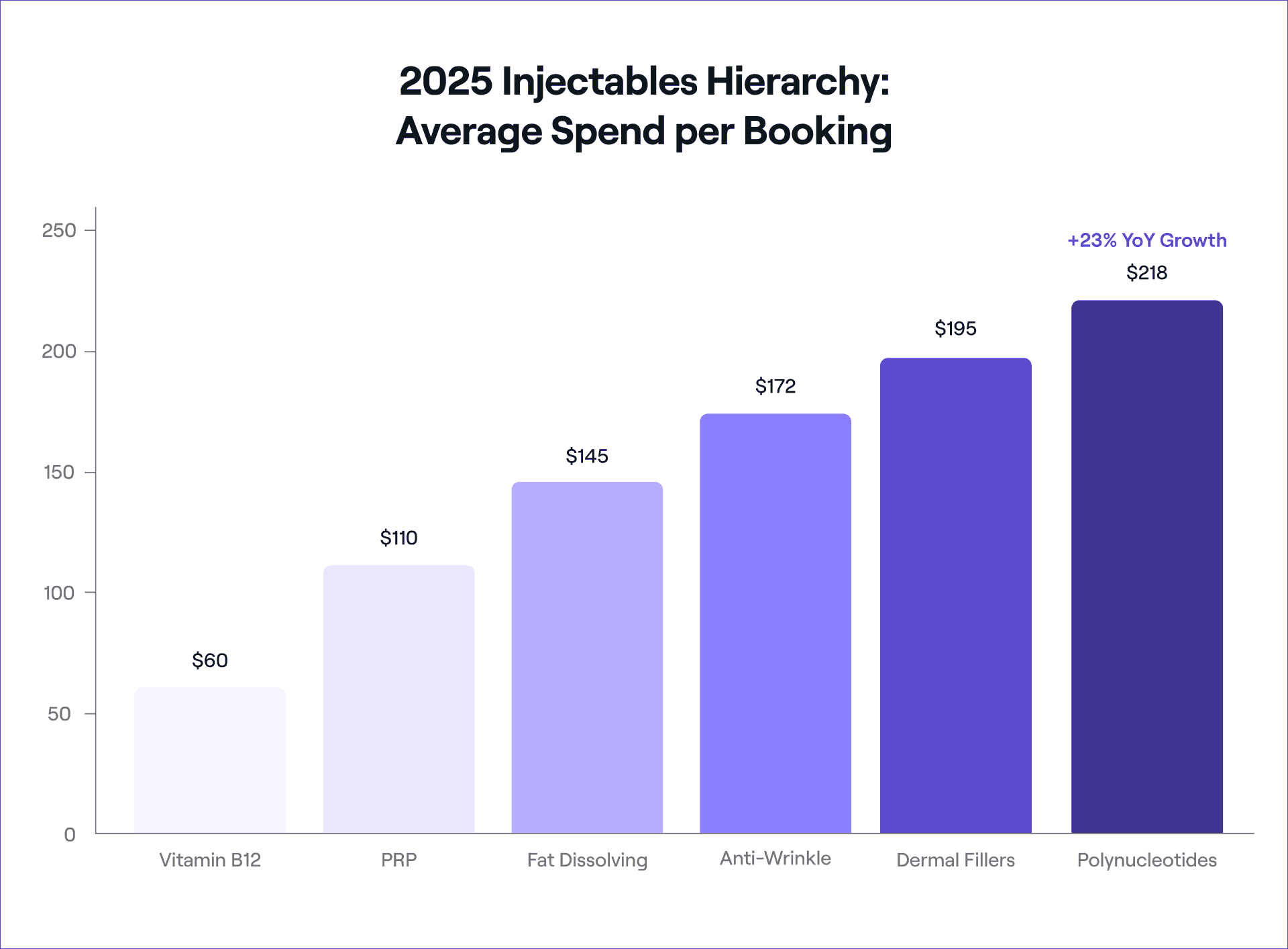
This growth reflects a broader shift toward regenerative and longevity-driven aesthetics, a theme increasingly dominant across the beauty and wellness sector.
“Polynucleotides genuinely feel like part of a wider mindset change towards longevity-focused, regenerative aesthetics rather than simply another trend-led injectable,” says Valerie, Aesthetics Specialist at London-based beauty and aesthetics salon, Browchuk by Vlada.
According to the Global Wellness Institute, longevity-focused beauty and aesthetic services are among the fastest-growing segments of the wellness economy, driven by consumer demand for treatments that support cellular health, regeneration, and preventative ageing rather than visible correction alone (Global Wellness Institute, Wellness Economy Monitor 2025). In many ways, it mirrors the rise of the viral “clean girl” era, which has undoubtedly reshaped not only skincare routines but wider lifestyle choices over the past few years. The focus has moved away from the visible correction of the 2000s, and more towards promoting skin health and embracing the outlook, ‘your skin but better.’
Cultural momentum has played an incredibly important role in the rise of polynucleotide injections. Over the past year, polynucleotides entered the mainstream conversation after being openly referenced by skin-praised celebrities such as Hailey Bieber and Kim Kardashian, accelerating awareness that extends well beyond those just ‘in the know.’ Interest surged on influential social platforms such as TikTok, where educational and testimonial-style content helped to demystify the seemingly invasive and slightly intimidating treatment and reframe it as a high-value skincare investment that is worth the momentary discomfort, rather than a one-off injectable.
“Social media plays a strong role in awareness, but in my experience, it often acts as a starting point rather than a final decision. Clients are coming in more informed and asking deeper questions about how treatments work, whether they support skin biology and how they contribute to long-term skin quality. Polynucleotides fit very naturally into this switch,” says Vlada.
This switch is reflected in search behaviour. In the past year alone, global searches for “polynucleotide” increased by a whopping 76%, peaking at 352,000 searches in November alone. This is a clear indicator that consumer curiosity heavily influenced active intent, and together, these signals make polynucleotides not just a trend, but a defining treatment in 2025 that will only continue to influence the next phase of injectable growth.
Find your nearest Polynucleotide appointment on Fresha ↗
Hair & Beauty
In 2025, hair and beauty continued to be one of the most influential pillars of selfcare, shaping how consumers discover, interpret, and invest in their wellness. As arguably the most visible and culturally dominant category online, hair and beauty sets the tone for wider beauty and wellness behaviour. Fresha data shows bookings driven less by transformation and more by maintenance, durability, and long-term results. It’s all about ‘your skin but better,’ a mindset that reflects that clean, low-maintenance aesthetic that dominated beauty culture over the past few years.
What does the data tell us? Let's explore the three key takeaways…
Facials that last…
Fresha customers are prioritising longevity-led beauty treatments
Low-maintenance may dominate beauty feeds after the Clean Girl virality, but when it comes to bookings, Fresha customers are playing the long game. In 2025, beauty remained one of the most frequently visited and booked categories on the platform, yet growth wasn’t driven by a higher visit frequency alone. Instead, customers increasingly opted for treatments that require multiple appointments, yet promise lasting results.
Across the regions, advanced facial treatments such as LED therapy, microdermabrasion, and chemical peels accounted for 17-26% of total facial bookings in 2025. This switch reflects a broader reframe in how beauty is being consumed. Routine maintenance appointments are still very much a thing. Still, customers are booking with intention, which is more often than not influenced by research or prior social media influence, choosing services designed to improve skin health over time.
This trend closely mirrors wider wellness behaviour. As highlighted by the Global Wellness Institute, consumer spend is moving toward preventative and longevity-focused services, and Fresha data supports this. As mentioned, in 2025, some of the most booked facial services focused on acne management, collagen stimulation, and barrier repair, all treatments rooted in long-term outcomes rather than instant transformation. Even search behaviour reflects this mindset turn, with global searches for “acne treatment” rising by 33% over the year.
Find your nearest facial obsession on Fresha ↗
Low maintenance is still in!
BIAB is reshaping nail bookings across the world
If longevity has become the new luxury in beauty, nails are no exception. In 2025, Builder in a Bottle (BIAB) increased its share of nail bookings across every region on Fresha, with standout momentum in Europe, North America, and the UK & Ireland. This is a clear indication that customers are craving results that last and feel worth it.
Think of BIAB as a tier up from gel polish and gel extensions. This is because it’s a strengthening gel that supports the natural nail while delivering on the smooth, glossy finish that customers know and love. It’s very quickly becoming the go-to alternative to acrylics and SNS, offering a cleaner look, much fewer breakages, and less upkeep.
“The biggest attraction is definitely the natural finish. BIAB enhances the nails without looking heavy or artificial, which really appeals to clients who prefer a clean, polished look,” says Venus Li, Founder of Nail Bar Venus to the Moon.
This change aligns closely with changing beauty preferences around durability, nail health, and natural finishes. Increasingly, customers are prioritising services that balance appearance with practicality, an outlook echoed across broader consumer trend reporting. The Pinterest Men’s Trend Report, for example, states that there is a growing appetite for low-maintenance beauty routines, reinforcing that this behaviour extends well beyond niche audiences and into the mainstream.
“Clients today are prioritising healthy, natural-looking nails that fit effortlessly into their daily lives. BIAB supports this shift perfectly. It strengthens the natural nail with a structured builder layer while maintaining a soft, natural finish. It’s comfortable to wear, easier to maintain and aligns with the growing focus on nail health. Compared to the 2010s, when long acrylic extensions and bold, high-contrast designs were very popular, today’s trends are much more refined,” continues Venus.
While gel continues to account for the largest nail share of global nail GMV, BIAB steadily absorbed demand from acrylics and SNS throughout 2025, particularly in more mature beauty markets where nail health and longevity are front of mind. Customers are understandably trading complexity and upkeep for strength, simplicity, and results that are going to last.
Find your nearest nail salon on Fresha ↗
Healthy hair is always on trend
Clients prioritise maintenance and repair over transformation
In 2025, hair bookings, in line with the rest of this report, continued to reflect a maintenance-first mindset. Rather than dramatic colour switches or one-off transformations, Fresha data shows clients prioritising services that protect, repair, and extend the life of their hair between appointments. 
Hair health services saw the strongest growth across the category. Straightening treatments nearly doubled with a +97% YoY growth, while conditioning services rose +79%, and toning and glossing bookings increased +76%. Together, these services point to a clear trend: clients are investing in treatments that improve hair quality over time, rather than chasing immediate visual change. This is a clear sign that the era of “bleach blonde in one appointment” is fading as Fresha clients go all-in on hair health.
This outlook also shows up in add-on services. Scalp treatments, hair masks, and conditioning upgrades all saw strong year-on-year growth, reinforcing that hair care is increasingly viewed through a wellness lens, not just an aesthetic one. This aligns with Global Wellness Institute insights linking scalp and hair care to preventative routines, confidence, and long-term maintenance (Global Wellness Institute, Wellness Economy Monitor 2025). Even as full colour and highlights remain core services, value is increasingly driven by what is paired with them.
Find your nearest hair salon on Fresha ↗
Wellness
Over 2025, wellness wasn’t just about switching off; it was all about feeling better, functioning better, and staying on top of routine. Treatments that support circulation, recovery, stress relief, and body maintenance are now firmly part of modern selfcare, sitting somewhere between health, beauty, and lifestyle. Thanks to pop culture moments like The White Lotus’ wellness-infused seasons, spas and ritual-led wellness experiences are more visible (and more desirable) than ever.
Let’s explore some key trends of this category…
Results-led body treatments are redefining wellness in 2025
Sculpting and drainage treatments now drive 50%+ of non-massage wellness bookings
Massage may still account for the majority of wellness bookings globally, accounting for over 90% of wellness bookings and more than 95% of total wellness spend across all regions. However, in 2025, incremental growth within wellness is increasingly being driven by sculpting and drainage-led body treatments rather than relaxation-first services.
While massage remains the backbone of the category, services positioned around visible and physical results are gaining share in both bookings and spend. Body sculpting now represents up to 2-2.5% of total wellness spend in regions such as Europe and North America, while drainage-led services such as lymphatic drainage, pressotherapy, and anti-cellulite treatments are collectively accounting for a growing portion of non-massage wellness revenue.
Customers are turning to wellness appointments that promise visible, physical results, not just a moment of calm. The Global Wellness Institute identifies this exact note in 2025, noting that consumers are gravitating toward wellness services that deliver measurable outcomes, particularly those tied to circulation, recovery, metabolic health, and body optimisation rather than passive relaxation (Global Wellness Institute, Wellness Economy Monitor 2025).
Practitioners are seeing this mindset change play out in real time. At London-based studio MASAJ, lymphatic drainage has emerged as a clear example of how wellness, recovery, and aesthetics are converging.
“There’s been a noticeable shift away from ‘pamper day’ treatments towards services that earn their place in a routine,” explains Cara Levy, therapist at MASAJ. “People are more informed, more time-poor, and more invested in how their bodies function day to day.”
Services such as body sculpting, lymphatic drainage, pressotherapy, anti-cellulite massage, and wood therapy now make up more than half of all non-massage wellness bookings on Fresha. These treatments are outcome-led, positioned around improved circulation, reduced fluid retention, body shaping, and recovery, reflecting a clear movement toward wellness that delivers measurable change.
As Cara notes, “Manual lymphatic drainage isn’t about forcing change; it’s about gently supporting the body’s own systems so recovery, balance, and long-term wellbeing can happen naturally.”
This trend is most pronounced in ANZ, Europe, North America, and the UK & Ireland, where wellness bookings increased year-on-year in 2025. In these regions, customers are increasingly using wellness services as part of structured body-maintenance routines, often alongside aesthetic and beauty treatments, rather than booking them as occasional indulgences.
Find your nearest massage destination on Fresha ↗
Wellness with traditional roots
Culturally specific treatments are gaining global relevance
In 2025, wellness customers are increasingly gravitating toward culturally specific treatments rather than generic massage or wellness services. Across regions, wellness methods such as Thai foot massage, Japanese massage, Lomi Lomi, reflexology, and herbal compress massage consistently appear among the top 20 most-booked wellness services on Fresha.
While these services account for a smaller share of overall wellness volume, they represent a stable and growing share of non-massage wellness spend, particularly in Europe, North America, and the UK & Ireland. Reiki alone now accounts for up to 1.5-2% of total wellness spend, so rather than booking broadly defined experiences, customers are making more intentional choices based on technique, origin, and perceived benefit. These treatments come with established cultural narratives around healing, balance, and recovery, allowing customers to select services that feel purposeful rather than interchangeable.
This change mirrors a broader global reawakening. Across indigenous and traditional cultures, wellness practices that were once overlooked are being reclaimed, not as trends, but as enduring systems of care. In markets such as New Zealand, for example, culturally specific treatments such as Rongoā Māori and the Polynesian Lomi Lomi Massage now sit alongside modern wellness services among the most-booked appointments, highlighting how heritage and modern selfcare are coexisting.
The consistent presence of these modalities across regions suggests this is not a niche or location-bound phenomenon. In 2025, wellness isn’t just becoming more results-driven; it’s becoming more considered, with customers seeking treatments that offer structure, meaning, and a sense of connection alongside the physical benefit.
Find your nearest spa destination on Fresha ↗
Men
For a long time, the male beauty sphere has been somewhat untouched or taboo. When thinking about men in beauty, it was only ever the barbershop that came to mind, coming across as a solely functional appointment. However, over the years, men’s selfcare has quietly evolved, and in 2025, grooming and wellness held a very clear change: male selfcare is no longer a transactional necessity, but an ongoing ritual tied to confidence, performance, and self-maintenance. As stigma continues to dissolve, men are engaging more deeply with services that prioritise longevity over quick fixes, and building routines just as normal as a morning skincare routine.
Let’s dive into the final key trends of 2025…
Men’s grooming moves beyond the haircut
Add-ons and precision services are changing up the classic barbering appointment
Throughout 2025, men’s haircuts remained the foundation of men’s grooming on Fresha, but the category growth over the past two years has been driven by more than just the cut itself. Since January 2023, men’s haircut bookings have increased by 87%, reaching nearly 2.9 million bookings in November 2025 alone (we predict the mullet craze acting as the pillar that held the barbering industry up). Aside from this, the fastest acceleration came from the services that are layered around the core appointment. 
Beard trimming bookings have more than tripled over the same period (+246%), climbing to 449,000 bookings in November 2025, significantly outpacing the haircut growth, essentially reshaping what a typical barber appointment looks like. Shaves followed a similar trajectory, with bookings up ~99% since January 2023, reinforcing the point that men are looking for an overall groom as opposed to a quick 30-minute appointment in the barber chair.
As the stigma continues to fade away from the male beauty realm, grooming is becoming less transactional and more intentional, with men placing greater value on the finer details, as well as searching for consistent outcomes. The Global Wellness Institute identifies this pivot as part of a wider movement toward preventative and confidence-led self-care, where consumers invest in services that support long-term maintenance rather than reactive fixes. Men’s grooming is increasingly aligning with this mindset, evolving from routine upkeep into a habitual form of personal investment (Global Wellness Institute, Wellness Economy Monitor 2025).
Find your nearest barbershop on Fresha ↗
Recovery-led treatments are bringing men into wellness
Performance, recovery, and optimisation now lead men’s wellness growth
Among all wellness services booked by men, recovery-led treatments emerged as the clearest growth driver. While overall wellness engagement among male customers continued to trail grooming and barbering in volume, the pace of growth within recovery-focused services significantly outperformed traditional relaxation-led offerings. 
Ashiatsu massage recorded the strongest YoY increase of any men’s service, with bookings up +274%, positioning it as the fastest-growing entry point into the category. This was closely followed by sensory deprivation treatments (+259%) and hyperbaric oxygen therapy (+107%), reinforcing demand for services that support physical therapy, and performance as opposed to just relaxation alone.
Rather than approaching wellness as an occasional indulgence, men are increasingly gravitating toward services that fit naturally into existing maintenance routines. Treatments positioned around recovery, physical upkeep, and long-term performance are gaining traction, reflecting a broader shift toward wellness that feels practical, structured, and results-led.
According to the Global Wellness Institute, recovery and physical optimisation are among the fastest-expanding pillars of the 2025 wellness economy, driven by rising consumer demand for measurable outcomes and preventative care. Fresha data mirrors this change, positioning recovery-led wellness as a defining growth vector in how men are expanding their self-care routines beyond grooming and into long-term wellbeing (Global Wellness Institute, Wellness Economy Monitor 2025).
Find your nearest recovery treatment on Fresha ↗
Summary
To summarise, in this report, we’ve explored multiple different verticals and, within them, multiple different wellness trends; however, one thing remained abundantly clear throughout: low maintenance is completely and entirely on trend. Selfcare is no longer about quick fixes or fast visible transformations, but all about longevity, maintenance, and intention. Whether through regenerative injectables, low-maintenance beauty services, results-led wellness, or the expanding role of men in grooming and recovery, consumers are building routines designed to last. In 2025, the most valuable services are those that fit seamlessly into an everyday, fast-paced lifestyle that delivers long-term outcomes with minimal upkeep.
As selfcare continues to evolve, the industry’s future lies not in doing more, but in doing better, and doing it consistently.
Related Articles