About surcharges
Learn how surcharges can be used by your business and how to apply these correctly, in line with regional regulations.
In this article
How surcharging works
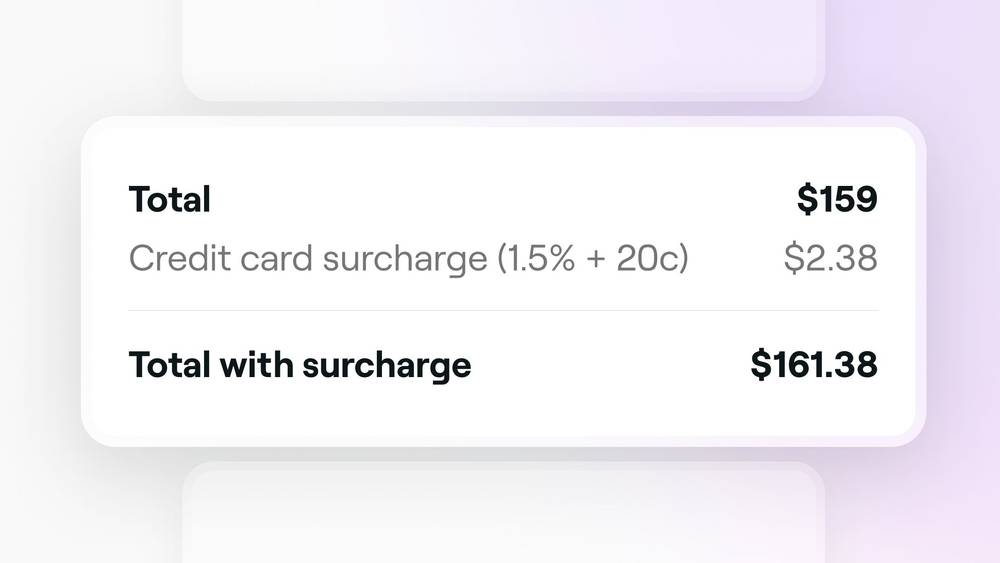
A surcharge (also known as a checkout fee) is a fee added to a client’s bill when they pay by card. This helps your business cover processing costs, where it’s allowed by law.
The surcharge you pass on to a client is the portion of the transaction fee charged by your payment provider. The fee must be charged to a client at the point of sale and cannot exceed the cost incurred by your business to process the card payment.
Some businesses build card processing costs directly into their service prices instead of adding a surcharge.
Surcharges are different to service charges which are applied at checkout and not linked to any payment processing fees.
Where surcharging is allowed
Surcharging rules vary by country and region, with different regulations for debit and credit card transactions. Currently, surcharging is permitted in the following countries (regional restrictions apply):
| Debit card | Credit card | |
|---|---|---|
| United States | NO | YES |
| Canada | NO | YES |
| New Zealand | YES | YES |
This information can change at any time, so please check that your business is covered in each country and region that you operate in and consult a legal expert for further advice.
- Disclose the amount that will be charged as a surcharge.
- Display clear and proper signage at the store entrance and point of sale (online or in-store).
- List the surcharge separately on the transaction receipt.
- Connecticut
- California
- Maine
- Massachusetts
- Oklahoma
- Disclose the amount that will be charged as a surcharge.
- Display proper signage at the store entrance and point of sale (online or in-store).
- List the surcharge separately on the transaction receipt.
- Quebec
- Disclose the amount that will be charged as a surcharge.
- Offer at least one surcharge-free payment method (like EFTPOS or debit cards).
In the United States, surcharges can only be applied to credit card payments. Debit and prepaid card payments cannot be surcharged, even if they’re processed as credit transactions.
Surcharges must adhere to card network rules and be applied equally across all credit card brands you accept, including Visa, Mastercard, and Discover.
Before processing a card payment you are required to:
Surcharging rules vary by state. The following states prohibit or limit surcharging:
If your business operates within these states, you cannot add surcharges to any card payments.
In Canada, surcharges can only be applied to credit card payments. Debit and prepaid cards cannot be surcharged, even if they’re processed as credit transactions.
Surcharges must adhere to card network rules and be applied equally across all credit card brands you accept, including Visa, Mastercard, and Discover.
Before processing a card payment you are required to:
Not all provinces and territories in Canada allow surcharging. The following province prohibits surcharging:
If your business operates within Quebec, you cannot add surcharges to any card payments.
In New Zealand, surcharges can be applied to both credit and debit card payments. If debit and credit card costs are different, your business must apply separate surcharges for each payment type.
Your business can apply surcharges on all card networks, including, Visa, Mastercard and Discover.
Before processing a card payment, you are required to:
You can find more information on surcharging rates and rules through card network providers such as:
FAQs
Surcharges are applied only at checkout and do not appear during online booking or when a client pays a deposit upfront. This is due to payment compliance requirements. Make sure applying surcharges is allowed in your country or region before using them.
If a client pays the full appointment amount upfront, you can still apply a surcharge at checkout. The surcharge is charged separately and is not included in the upfront payment.
It’s your responsibility to ensure that applying surcharges complies with local laws and regulations. Fresha does not determine whether surcharges are permitted in your location.
From 1 October 2026, new rules from the Reserve Bank of Australia will remove surcharging on card payments for businesses in Australia. If your business is based there, consider building your card processing costs into your service prices ahead of this date instead.