Nail Salon Interior Design & Layout: A 2026 Operator's Guide

Nail Salon’s are not just a hair salon with smaller chairs. The services are different, the client behaviour is different, and the practical demands of the space are completely different too. What works beautifully in a hair salon can actively work against you in a nail bar - take a look at some of the amazing partners on the Fresha’s marketplace for inspo.
Ventilation, plumbing, lighting accuracy, and material durability all matter more in nails than in almost any other beauty vertical. These are the details that shape how comfortable the salon feels, how well the services perform, and ultimately whether clients come back.
Tinu Bello, Founder of Manicured London, kept salon design at the forefront of their plans:
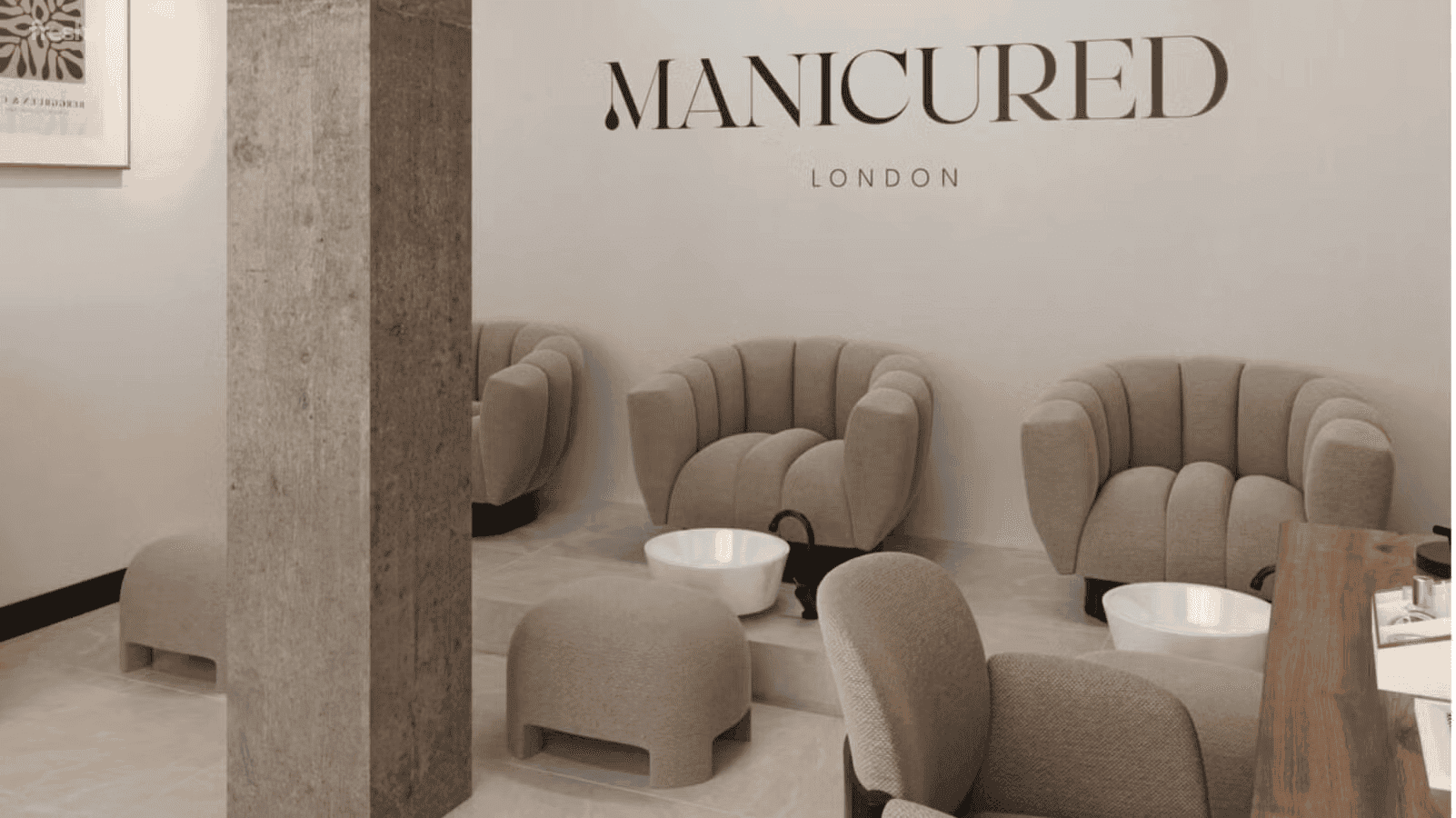
“From the very beginning, I wanted Manicured London to feel like somewhere everyone could walk into and feel at home, regardless of gender, age, or background. Most nail salons lean heavily feminine, and while that works for some, it can feel exclusive. I wanted to design the opposite. A calm, neutral, considered space where men, women, and anyone in between could sit down and feel comfortable getting their nails done.
Our photos do a lot of the work for us. People discover us on Fresha or Instagram, see the studio, the exposed concrete, the loft feel, the calm monochrome palette, and immediately understand what they're booking into. That visual clarity removes any hesitation. They know exactly what they're walking into.”
It’s only normal to feel overwhelmed when designing a space you’ve poured your heart into so our guide walks through what makes the nail vertical different, the eight design moves nail bars in 2026 are getting right, four layout templates by service type, and the vertical-specific mistakes that cost real money on a fit-out, aimed at owners planning a new nail salon, established owners running a refresh, and operators adding nail stations to an existing salon.
What makes nail salon design different
Nail salons have so many different elements to them, and are more often than not, home to multiple nail technicians who all work in the same space. There are a few key aspects of a nail salon that need to be thought about, which could be different from other verticals out there.
Ventilation
Nail salons deal with acetone fumes, acrylic dust, polish vapours, and monomer all day long. Air quality is not just a comfort issue here. It affects client experience, staff wellbeing, and in many markets, compliance too.
Proper extraction systems can cost anywhere from $5,000 to $25,000 depending on the size of the salon and whether the system is integrated into HVAC. That sounds like a big line item until you compare it to the long-term cost of poor ventilation: uncomfortable clients, higher staff turnover, and salons that simply never feel fresh.
Clients notice good ventilation immediately, even if they can’t explain why the salon feels cleaner and calmer.
Plumbing
Pedicure chairs completely shape the layout of a nail salon.
Each chair needs water supply, drainage, and often additional electrical work too. In practice, every pedi chair becomes its own mini plumbing project. Adding a chair later can cost anywhere from $3,000 to $10,000 per station once walls and floors need reopening.
That’s why service mix needs to come before layout planning, not after it. One of the smartest things salon owners can do is rough plumbing for future expansion early, even if they only open with a smaller number of pedi chairs.
Lighting precision
In nail salons, the service itself is visual. Clients are judging colour, shine, finish, and detail constantly.
That makes lighting incredibly important. CRI 90+ lighting at every manicure station should really be considered non-negotiable at this point. If the lighting is even slightly off, polish shades can look completely different at home compared to in the salon.
And because nail clients photograph everything, lighting affects far more than the in-person experience. It affects Instagram posts, reviews, referrals, and rebooking too, read more in our guide about salon lighting.
Surface chemistry
This is where a lot of beautiful fit-outs quietly fail as some materials simply are not designed to survive life inside a nail salon. Marble stains under acetone, timber warps and delicate laminates wear down quickly under constant exposure to solvents, dust, spills, and aggressive cleaning.
The best nail salons choose materials that can actually handle the environment long term. Sealed quartz, porcelain, specialist laminates, and sealed concrete tend to perform far better over time.
A salon that still looks polished after two years will always feel more luxurious than one already showing damage after six months.
Photography ergonomics
Let’s face it, the finished set always ends up on Instagram, TikTok, Pinterest, Stories, reviews, and group chats often within minutes of the appointment ending. The salons getting the most user-generated content in 2026 are designing around this intentionally. Not only that, these images act as huge marketing campaigns; whether they’re placed on Fresha’s marketplace or on our socials, our visibility lands salons on worldwide publications, and on the phones of potential clients.
Lighting angles, counter colours, backgrounds, and even station height all influence how the final result photographs. The best salons understand that every appointment is also marketing. The biggest mindset shift is that nail salon design is part beauty business, part technical workspace. When the technical side works properly, the aesthetic side lands much harder.
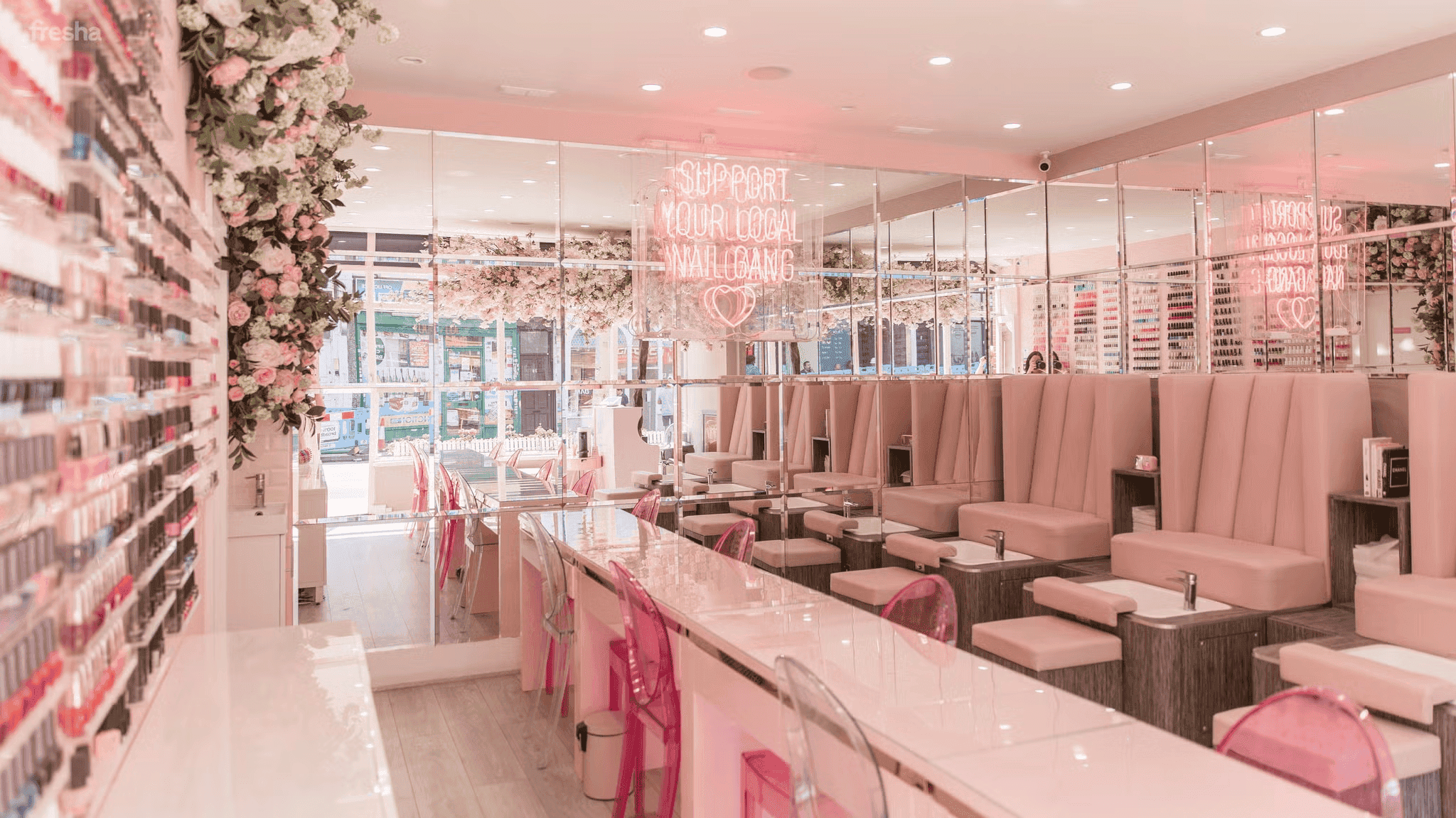
The 5 design moves nail bars in 2026 are getting right
Being honest, the best nail salons right now are not necessarily the biggest or the most expensive. They’re just more intentional. Every design decision works harder, whether it improves the atmosphere, supports operations, or helps the salon photograph better online. We’ve seen nail salons worldwide, as Fresha partners with over 130K businesses on the world’s most extensive marketplace.
These are the five design moves we’re seeing the strongest nail bars get right in 2026.
1. Ventilation that feels invisible but works hard
The best salons are no longer treating ventilation like something to hide awkwardly in the corner. They’re integrating it directly into the design of the space, which is exactly what our partners are doing on Fresha.
Ceiling-integrated extraction, sculptural vent covers, concealed airflow systems, and decorative diffusers all help the salon feel cleaner and more premium without looking overly clinical. Clients notice when a salon feels fresh immediately, even if they can’t explain exactly why.
And this is one area where spending matters. Ventilation systems can cost anywhere from $5,000 to $25,000, depending on the setup, but poor airflow quickly affects client comfort, staff wellbeing, and the overall feel of the salon.
2. Photo-ready lighting at every station
Nail salons are designing for cameras now, not just for clients sitting in the chair.
That means CRI 90+ task lighting at every manicure station, softer ambient lighting throughout the salon, and designated areas where clients can photograph the finished result properly. Some salons are even adding small styled “photo corners” specifically for post-appointment content.
Lighting affects far more than visibility. It changes how polish colours appear in person, how the salon photographs online, and how premium the experience feels overall. The salons getting the most reposts and tags in 2026 are designing for this intentionally.
3. Better spacing and smarter layouts
Spacing matters more than most salon owners realise.
When manicure stations sit too close together, the salon immediately starts to feel cramped. Conversations overlap, technicians lose the working room, and the whole atmosphere becomes chaotic surprisingly quickly.
Around 36 inches between facing manicure stations tends to be the sweet spot. Enough room for comfort and privacy without wasting valuable floor space.
The strongest layouts also separate service zones properly. Manicure stations usually work best towards the front of the salon, while pedicure chairs feel calmer and more comfortable positioned towards the back near the plumbing runs.
4. Durable materials that still feel elevated
This is where a lot of beautiful nail salons quietly fail.
Some materials simply don’t survive long-term exposure to acetone, dust, spills, and constant cleaning. Marble stains. Untreated timber warps. Delicate finishes wear down quickly.
The salons ageing best are choosing materials that balance durability with aesthetics. Quartz, porcelain, sealed concrete, and specialist laminates tend to perform particularly well in nail environments.
And honestly, durability is part of luxury. A salon that still looks polished after two years always feels more premium than one already showing damage after six months.
5. Designing the salon for content and retail
The strongest nail salons in 2026 understand that every appointment is also marketing.
Clients photograph their nails constantly, which means the salon itself becomes part of the content. Lighting angles, counter colours, backdrops, and even the polish wall all influence how the final result photographs online.
That’s why the polish wall has become such an important design feature. The best ones feel curated rather than cluttered, with open shelving, colour-grouped displays, and proper lighting that turns the retail area into a focal point for the space.
Layout templates by nail salon type
The best layout depends less on square footage and more on your actual service mix. A mani-only salon and a luxury pedi studio are completely different design problems, even if they occupy the same amount of space.
Mani-only nail bar
This is one of the simplest and most efficient layouts. Manicure stations usually sit along the longest walls, with reception and retail positioned near the entrance. Without pedicure plumbing, the fit-out becomes significantly easier and often $10,000 to $30,000 cheaper overall. This setup works especially well for high-volume city-centre, mall, and high-street locations where speed and turnover matter.
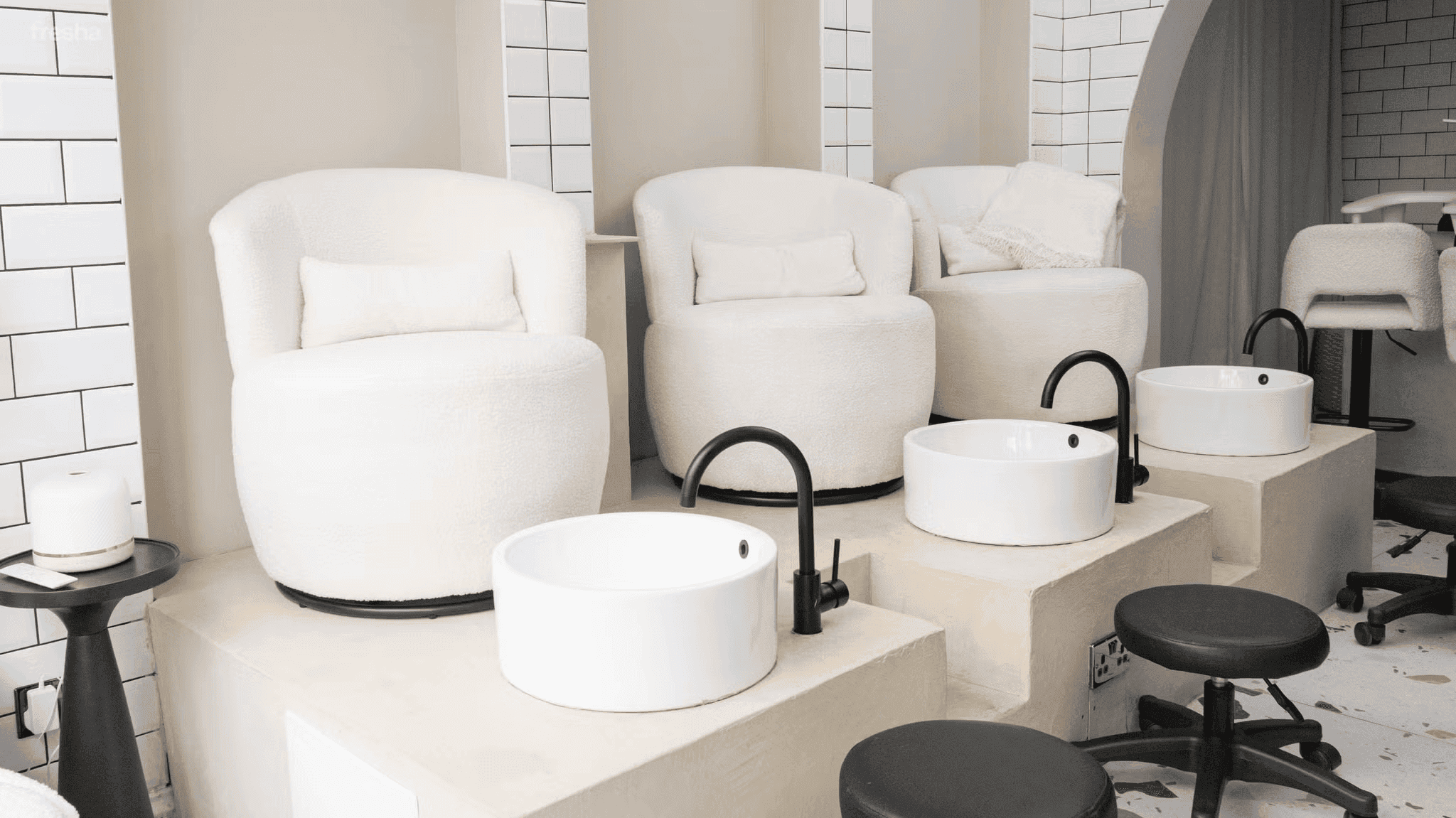
Awe London, Shoreditch, London
Mani-pedi mixed salon
This is the classic nail salon layout for a reason as manicure stations sit towards the front while pedicure chairs live towards the back near the plumbing runs. Operationally, it makes sense. Visually, it helps the salon feel balanced too.
The manicure area feels brighter and more social, while the pedicure zone naturally feels calmer and more relaxed.
Pedi-luxury throne studio
Luxury pedicure concepts prioritise comfort and experience over density. Large pedi thrones usually line the perimeter of the salon with softer lighting, more privacy, and a more spa-like atmosphere overall. These concepts require significantly heavier plumbing infrastructure though. Six pedi chairs can mean anywhere from $12,000 to $60,000 in plumbing costs alone.
They also support longer appointments and higher-ticket services, which changes the economics of the space entirely.
Nail stations inside a hair salon
Adding nail stations to an existing hair salon can work extremely well, but airflow becomes critical.
Without proper extraction and separation, nail fumes and dust quickly travel into the hair section. The best setups combine dedicated extraction with physical partitioning so both services can coexist comfortably. This is one of the most common mistakes salons make when expanding into nails.
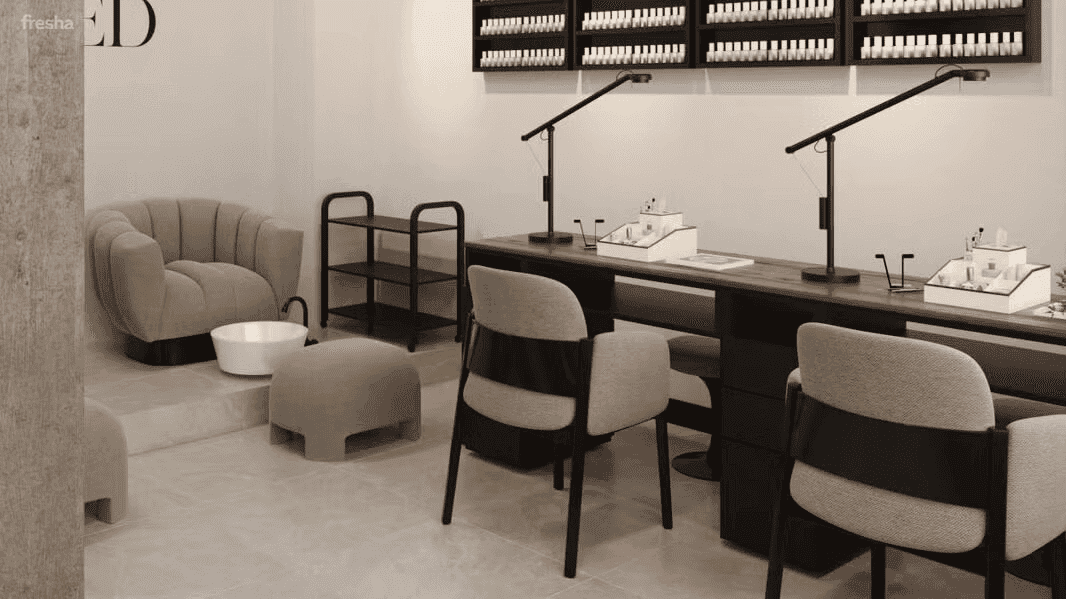
Tinu, Founder of Manicured London, explained:
“Once the (the clients) are here, the environment is what turns first-time clients into regulars. A beautiful, inclusive space makes the decision to come back feel automatic. They're not just paying for nails, they're buying access to an experience they want to return to.
The design also supports the team. A calm, organised space means our technicians can focus on craft and connection rather than chaos, which leads to better work, happier clients, and stronger bookings.”
Frequently asked questions
How do you design a nail salon?
Start with the constraints unique to nails: ventilation, plumbing, surface chemistry, lighting, and photo ergonomics. Decide your service mix (mani-only, mani-pedi mixed, pedi-luxury) before the floor plan, because plumbing locations follow service mix. Then layer the universal design principles: light palette, vertical space, one hero piece (the polish wall is usually it). The eight design moves listed in this guide cover the nail-specific layer.
How much does it cost to design a nail salon?
Budget tier: $40 to $80 per square foot. Mid-tier: $100 to $180 per sq ft. Premium: $200 to $400 or more per sq ft. Nail salons run higher per-sq-ft costs than hair salons because of ventilation ($5,000 to $25,000), pedicure plumbing ($2,000 to $10,000 per chair), and specialised lighting. For a 1,000 sq ft nail bar at mid-tier, $120,000 to $180,000 total is realistic before furniture and retail stock.
What is the best layout for a nail salon?
Depends on your service mix. Mani-only: stations along the longest walls facing the centre, retail at the front. Mani-pedi mixed: manicure stations at the front near reception, pedicure chairs at the back near the plumbing run. Pedi-luxury: pedi thrones along the perimeter with manicure stations in the centre. In all configurations, the polish wall should be visible from the door.
What lighting is best for nail salons?
CRI 90 or higher at every manicure station, non-negotiable for polish colour accuracy. Warm ambient lighting overhead at around 3000K. Ring-light-style mirror lighting at pedi stations. One styled photo nook with daylight-balanced lighting where clients can photograph the finished nails. Your lighting budget should run 10 to 15% of total fit-out spend for nail salons specifically.
How much space do you need for a nail salon?
Functional minimum: 100 to 150 sq ft per single station (mani or pedi). Common configurations: 600 to 800 sq ft for a 4-station mani-pedi mixed salon, 1,000 to 1,500 sq ft for a 6-to-8 station nail bar, 1,500 to 2,500 sq ft for a luxury pedi-throne studio. Allow additional space for ventilation, reception, retail, and storage on top of the working footprint.
Building a nail bar clients book and rebook
Nail salon design is a chemistry problem first and a beauty problem second. Get the constraints right (ventilation, plumbing, lighting, materials, photo ergonomics) and the rest of the design works. Skip them and no aesthetic effort recovers the result.
For the principles, budget tiers, and the 5-step plan that turn these nail-specific moves into a complete fit-out, see the full salon design playbook.
The best nail salons are rarely the ones with the biggest budgets. They’re the ones where everything feels considered. The lighting is flattering, the atmosphere feels calm, the layout flows naturally, and every detail quietly supports the experience from start to finish.
👉 If you’re planning a new nail salon or refreshing your current space, Fresha gives beauty and wellness businesses the tools to run smarter, grow faster, and create standout client experiences from day one. Explore Fresha for Business here today.
Related Articles
How to Price Your Lash and Brow Services: A Salon Owner's Guide
by Iasmina Ionescu on July 28, 2026
The global eyelash extension market was valued at $1.61 billion in 2022 and is projected to reach $3.09 billion by 2030, growing at a compound annual rate of 8.6%, according to Grand View Research. Brow lamination, barely a mainstream service five years ago, now commands waiting lists in major US cities. Demand has never been stronger, so learning how to price accordingly is setting you up for success.

Why You Should Add Keratin Treatments to Your Salon Menu
by Iasmina Ionescu on July 20, 2026
Let's talk about one of the most reliable revenue drivers in hair - keratin treatments. The business case is genuinely straightforward - a keratin treatment takes two to three hours, and our data at Fresha shows treatments are usually priced at $150 to $600, depending on hair length and your market (pricing benchmarks sourced from Fresha and Salon Today's annual pricing survey). Compare that to a standard blowout at $45 to $65.